[Press Release] Colorado Governor’s Office of Information Technology Hires Three Apprentices Through ActivateWork
For Immediate Release
Contact: Tassi Keith, Keeton PR, tassi@KeetonPR.com, 308-539-1883
DENVER, COLO. — Mon., March 13, 2023 — ActivateWork announced today that three graduates of their training program were hired as developer apprentices by the Colorado Governor’s Office of Information Technology (OIT) through a new partnership. The apprentices are recent graduates of ActivateWork’s Software Engineering course and will serve up to 18 months in their roles.
“The Governor’s Office of Information Technology is building the talent of tomorrow with apprentices to serve all Coloradans today. Registered apprenticeship programs are an inclusive model for workforce and career development,” said Anthony Neal-Graves, Chief Information Officer and Executive Director at OIT.
“We are eager to work with three of the graduates from ActivateWork’s training program, which prepared apprentices for their roles and will ensure ongoing professional coaching and support to set them up for success.”
According to the 2022 Colorado Tech Industry Report from Colorado Technology Association, every year an average of 41,550 tech jobs need to be filled to accommodate for growth and retiring workers, and software developers account for almost 12 percent of the tech workforce. Denver-based non-profit ActivateWork connects employers to a diverse pool of exceptional talent and has three registered apprenticeships. The Software Development apprenticeship is the newest, and OIT is the first organization to hire apprentices within the program. ActivateWork’s other apprenticeships include Cybersecurity and DevOps, and all provide earn-while-you-learn career pathways to Coloradans. Through the apprenticeship programs, ActivateWork is helping Colorado employers to build their own talent pipelines with diverse, qualified candidates.
“We are excited to partner with OIT to launch this software development registered apprenticeship program to help them solve their IT talent gap and create a new economic mobility pathway for other employers in Colorado,” said Kathryn V. Harris, COO at ActivateWork. “Not only do our apprentices have their employer mentors and supervisors, but ActivateWork also provides a career coach and an apprenticeship coordinator to create comprehensive supports for each apprentice.
“Apprenticeships allow employers to build an evergreen talent pipeline with the exact skills they need for their in-demand roles. We applaud OIT for leading the way, leveraging this promising strategy to solve persistent talent gaps.”
Each OIT apprentice completed a 15-week Software Engineering pre-apprenticeship boot camp through ActivateWork, where they were immersed in full stack development and software development life cycle topics for more than 400 hours. Their graduation from the program qualifies them to enter the apprenticeship with the aptitude and skills to become a junior software developer.
The apprenticeship program addresses business needs by providing talent for hard-to-fill roles and solving the need for equity and inclusion in tech. ActivateWork CEO and Founder Helen Young Hayes explained, “We recruit people from underrepresented communities and provide rigorous, industry-informed IT skills training paired with durable soft skills, preparing them for successful careers. We know that on a national level, 93% of apprentices transition into permanent employees; we’re confident our apprentices will experience similar success rates.”
The OIT Developer Apprentices will work as part of the office’s existing developer teams.
Photos available upon request.
About ActivateWork
ActivateWork is a talent solutions organization that transforms high-potential individuals into highly skilled, valuable team members. Our rigorous recruiting, industry-driven training, curated matches, and professional skills coaching prepare new employees to thrive in their careers. For more information, visit www.activatework.org.
[Contact information and boilerplate updated August 11, 2025]

[Podcast] Colorado Voices on Tech: A Conversation with Helen Young Hayes
Colorado Voices on Tech: A Conversation With Helen Young Hayes [Podcast]
 Colorado Voices on Tech is a podcast hosted by Frannie Matthews, President and CEO of Colorado Technology Association, featuring conversations with leaders and innovators driving advancements in our community and in business through technology. Through these fast-paced conversations, listeners learn about emerging tech trends, how technology influences the world around us, and the ways that the Colorado tech ecosystem is contributing to the technology landscape worldwide.
In this episode from February 24, 2023, Frannie spoke with ActivateWork’s founder and CEO, Helen Young Hayes, about her approach to connecting diverse, qualified talent to leading employers in the Colorado tech community—not only to advance economic and professional success but to transform lives through learning the mastery of new habits, mindsets, and disciplines.
Listen to the conversation on Buzzsprout
[Interview] CEO Spotlight with Helen Young Hayes Founder & CEO of ActivateWork
ActivateWork Founder and CEO Helen Young Hayes was featured in a CEO Spotlight on Denver’s Talk Station 630 KHOW in January 2023. Listen to the interview below, or visit iHeart Media’s website to listen to the original recording.
CEO Spotlight with Helen Young Hayes on Denver’s Talk Station 630 KHOW
January 27, 2023
[ColoradoBiz] Helen Young Hayes Talks Talent Pipeline Disruption [Guest Column]
This guest column was written by ActivateWork founder and CEO, Helen Young Hayes, and was originally published by ColoradoBiz on December 15, 2022. Read the original article here.
Guest Column — Helen Young Hayes Talks Talent Pipeline Disruption
Up-to-date and rigorous job skills training, technology bootcamps and apprenticeships are not only sufficient, but in many ways are superior.
Thurs., December 15, 2022
Why do employers still rely on a four-year degree as an indicator of job readiness? Especially in fields where technology rapidly changes, a majority of companies continue to screen candidates by requiring a university education. A computer science degree that includes humanities and general education credits is often required to prove one’s ability to do well in fields like cybersecurity. In fact, up-to-date and rigorous job skills training, technology bootcamps, and apprenticeships are not only sufficient, but in many ways are superior.
As employers face critical IT worker shortages and cybersecurity threats become more ominous, employers in tech must embrace these alternative credentialing strategies to broaden their talent pipeline.
But we need more than just ensuring employers can acquire talent quickly. Traditional hiring, which may overlook those without four-year computer science degrees, leaves out vast segments of our population. U.S. Ambassador Susan Rice recently remarked that there are 700,000 vacant cybersecurity jobs, but the current field is made up of less than 25% women, 9% black, and 4% Hispanic workers. Fortunately, those numbers are the impetus for the National Initiative for Cybersecurity Education and the Cybersecurity Workforce Framework that will help K–12 teachers introduce cyber curricula and resources. But the need is urgent. We must call upon private industry to also recognize the need for technical job preparation outside of a university setting. Or as Rice says, “create new pathways” for those who did not or cannot attend a university.
Importantly, providing a method for advanced technical job skills training for non-college students is a matter of economic equity. People deserve to achieve their fullest potential and pursue economic freedom even without the resources to attend a four-year university. In Colorado, 64% of top jobs require a post-secondary credential, yet only 28% of Blacks and 17% of Hispanics in Colorado attain a bachelor’s degree. According to the Colorado Talent Equity Agenda, Colorado ranks 37th in terms of racial disparities, measuring how well the state puts households of color on a pathway to economic prosperity.
Consider a report from the Bureau of Labor Statistics on income disparity based on college attendance. Families that include at least one wage earner with a bachelor’s degree have nearly 8 times the wealth of families without a college graduate.
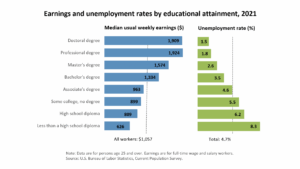
If Americans can afford college degrees, they’re rewarded with a better job. But they’re not necessarily coming to those jobs with in-demand skills. According to a Harvard Business School survey, employers perceive that a college degree does not necessarily guarantee higher productivity or faster promotion rates in middle skills jobs. Companies need to hire for skill sets, not sheepskin, and widen access to employment in an equitable way. Job skills training and certifications must be promoted to the populations least likely to attend universities and embraced by the companies that will benefit from skilled technical talent.
Companies need talent today. In the last decade, 9.8 million jobs were created, and due to new technology and retiring baby boomers, there are more than 35 million jobs waiting to be filled. According to Georgetown University’s Center on Education and the Workforce, only 36% of those job openings will be available to workers with less than a bachelor’s degree. Short-term credentialing, job skills training, and apprenticeship programs build desired skills and add to the existing talent pool inclusively and efficiently. Companies must embrace and implement programs and credentialing that screen in the skills they want, rather than screen out the workers they need.
In short, it’s time to rethink the education and hiring process so that every member of our society has the ability to learn and earn.
Helen is the founder and CEO of ActivateWork, a nonprofit recruiting, training and coaching firm that connects employers to a diverse pool of exceptional talent.

Partners with Purpose: ActivateWork and PCs for People Colorado

ActivateWork prepares adult learners for careers in tech—including cybersecurity, networking, IT Support, and data analytics—but many of our learners do not have access to the technology required to take courses virtually. Enter PCs for People Colorado, a nonprofit that provides low-cost internet and quality refurbished computers to individuals and other nonprofits.
The relationship between the two organizations was formed in March 2020, when the pandemic dictated that ActivateWork’s bootcamp training program be moved completely online. However, some of our learners didn’t have the technology to access the virtual labs and Zoom classroom sessions.
PCs for People not only provided computers for our learners, but they’ve also continued to help ActivateWork expand its reach; nearly half of all ActivateWork learners require a loaner PC to complete their programs.
 Beyond the classroom, PCs for People has helped ActivateWork gift graduates with computers after they complete our rigorous bootcamps. This allows individuals to continue their online job searches and bridge the digital divide in their homes.
Beginning December 2022, PCs for People will host ActivateWork learners one day a week to provide more hands-on experience during their Desktop Support training. Using computers donated by PCs for People, learners will assess computers, test peripherals, load operating systems, and troubleshoot common issues they’ll face as IT support professionals.
[Forbes] Can Apprenticeship Meet The Demands Of The Future Of Work?
Alison Griffin of Forbes.com sat down with ActivateWork founder and CEO Helen Young Hayes to paint a picture of today’s apprenticeship landscape. Read or listen to the original article here.
Can Apprenticeship Meet The Demands Of The Future Of Work?
Listen to this article on Forbes.com
November 16, 2022
By Alison Griffin

This week, the nation is celebrating National Apprenticeship Week. However, unlike the fanfare around “Back to School” or “Teacher Appreciation Week,” our local school has been silent in its elevation or celebration of this increasingly popular work-based learning model. Meanwhile, if my teenage boys were in high school in Switzerland, they would have been hearing about apprenticeships for years as a pathway to career opportunity. In the United States, that has not historically been the case, but things may be starting to change.
Colorado is one state where “apprenticeship” is not an unknown term (hence my surprise that I have not heard a peep about it from school). From the early days of General Assembly expanding their unique tech training model to the Denver area. Then we saw the rise of CareerWise Colorado, founded by national apprenticeship champion Noel Ginsburg. Today, an emerging cohort of fast-growing apprenticeship providers like Multiverse are looking to Colorado given the state’s growing need for tech talent. Suffice to say Colorado is no stranger to innovative education and employment options.
But why and how did Colorado become such a hub for this trending future of work option? It’s in part due to political champions for the apprenticeship model, such as now Senator John Hickenlooper, who saw CareerWise Colorado grow in popularity and reach under his term as Colorado’s Governor. Followed now by Governor Jared Polis and countless policymakers at the state and local level who have become champions for apprenticeship as an option for learners beyond high school. Support for apprenticeships is gaining traction at the national level, too, with everything from initiatives by the White House, national partnerships like the Partnership to Advance Youth Apprenticeship (which includes CareerWise Colorado), the launch of new organizations such as Apprenticeships for America, and more that are all advocating for new policies that will streamline and expand access to earn-and-learn opportunities.
And not a minute too early. The number of youth apprentices starting a program has more than doubled in the last 10 years – jumping by 113 percent between 2010 and 2020. And it’s no surprise, then, that federal funding for Registered Apprenticeships has increased as a result. And though we are seeing this steady growth, there is debate about equity gaps in youth apprenticeship participation, meaning more needs to be done to make this option readily available for American learners. Needless to say, the time is coming for National Apprenticeship Week to be far more noticeable on our radars and in our schools, because when it comes to “the future” of work, this is it.
I wanted to learn more about the current landscape and the future of apprenticeship in Colorado, but also as a critical component to the future of work. I sat down with Helen Young Hayes—founder and CEO of ActivateWork, a nonprofit recruiting, training and coaching firm that connects employers with a diverse pool of talent—to paint a picture of today’s apprenticeship landscape.
Alison Griffin: What inspired your work in the apprenticeship space and where has that inspiration led you today?
Helen Young Hayes: I believe that talent is equally distributed, but opportunity is not. In 2016, I started ActivateWork to help Coloradans achieve economic freedom through the dignity of work. We are a bridge. We connect jobseekers with jobs. And we connect people’s inherent potential with their realized success.
Our goal is not merely economic self-sufficiency. We want our clients to achieve economic flourishing. So, we connect employers with workers who possess four key qualities that predict on-the-job success: work ethic, initiative, follow-through and coachability. And we coach each new hire for 12 months to ensure they excel in their new role and achieve their fullest potential.
We began by placing people into careers in healthcare, financial services, and skilled trades. In 2020, we launched our IT training program, adding rigorous technical training and credentialing. Our partner, Per Scholas, has trained and placed over 16,000 IT professionals from communities often underrepresented in technology.
Over the next five years, we will catalyze over 1000 people into lucrative IT careers. The U.S. technology industry is overdue for innovation. There is a growing 1.2-million-person IT talent shortage, and higher ed is simply not producing enough computer science graduates. Since forty percent of tech jobs do not require a college degree, employers should be increasingly more open to alternative credentials. Many of our IT employer partners report they value industry certifications and hands-on experience more than a computer science degree.
Apprenticeships help employers develop the exact skills and talent they need for the present and the future, important for hard-to-fill roles. Other benefits include government training subsidies and employee retention rates of over 90% for completed apprentices. Importantly, through apprenticeship, companies are adding to (not competing for) existing talent.
With a severe talent gap, IT is an industry ripe for apprenticeship. Colorado ranks 4th in the nation for tech employment, with 120,000 tech workers earning an average of $104,000. There are currently 30,000 IT job openings and one job opening for every existing IT worker. If filled, those open jobs would add $2 billion to the GDP of our state.
By equipping people with in-demand skills and industry certifications for high-paying roles— debt-free and on-the-job—apprenticeship builds the skilled and diverse workforce we need for today and the future.
Alison: In the state of Colorado, there have been many efforts to integrate apprenticeships into the common vernacular whether through policy, practice or program. What exists today and where are there still gaps in this growing space?
Helen: Apprenticeships are common in the construction trades, but vastly underutilized in the U.S., which has a labor force of 160 million. In 2020, there were 636,000 U.S. apprentices and 82,000 completers nationwide. In Colorado, there are only 6,100 individuals enrolled in apprenticeship, which is less than two-tenths of one percent of our labor pool!
Increasingly, high-skill occupations in IT, aerospace, healthcare, and advanced manufacturing do not require a college degree but require technical or industry certifications or apprenticeships. Leading employers such as Microsoft, Google, Accenture, and IBM have reduced 4-year college degree requirements and use apprenticeships to develop talent for in-demand jobs.
There are many reasons why apprenticeship is underutilized. First, apprenticeships are not prevalent in the U.S. and represent less than half of one percent of our total U.S. workforce. Compare this with Switzerland, where two-thirds of high school graduates choose apprenticeship over college.
Second is the widely held belief that college is the only pathway to economic and professional success. That’s simply not true. The average starting salary for a 4-year college graduate is $55,000, compared to $72,000 a year for an individual who has completed a registered apprenticeship. We must expand the definition of education to include alternative learning pathways and to combat the unspoken stigma associated with vocational and professional credentials.
Additionally, most employers (outside of construction) are unaware of registered apprenticeship as a talent development strategy. Most business leaders confuse apprenticeship with internship and rely on traditional and ineffective talent strategies to fill their vacancies (like poaching talent from competition). Apprenticeships are mushrooming in a variety of industries, including finance, healthcare and IT. In fact, IT/cybersecurity is the fastest growing category of apprenticeship in Colorado and represents 30% of new registered apprenticeships.
Alison: What is the difference between a youth apprenticeship and what it offers a student and an apprenticeship for those beyond the grade school age? Why is it important to differentiate these pathways?
Helen: Youth apprenticeship and adult apprenticeship reach two different populations, under-18 and over-18 years of age. They should be developed side-by-side. Youth apprenticeship provides high schoolers with work-based learning and earning opportunities, equipping them with in-demand skills. Youth are the workforce of our future, and we should position them for success in a rapidly evolving economy.
But youth (16-24) represent only 12% of our workforce. Given trends in automation, AI, and remote work, some 17 million Americans will need to transition to higher-skill occupations by 2030. The adult population—the bulk of our workforce—will also need to upskill rapidly, and apprenticeship enables Americans to learn these skills debt-free and on-the-job while linking them to an employer who invests in them.
I should note that registered apprenticeships are formal workplace-based training programs. Participants receive industry-specified technical instruction and wages from employers. Upon completion, participants receive a nationally recognized certification administered by the Office of Apprenticeship at the U.S. Department of Labor.
Alison: It sounds like learners of many – really any – ages can participate in apprenticeship programs. How do we de-stigmatize these pathways for all learners? How can schools, communities and employers be involved in making apprenticeship the ‘norm’ for learners?
Helen: You’re right—any age can participate in apprenticeship. Our IT learners have ranged in age from 18-71. The first thing employers should do is start developing apprenticeship as a talent development strategy and then broadcast their success.
I sit on Colorado Governor Polis’ Business Experiential Learning Commission. Our mission is to promote employer adoption of apprenticeship and to recommend policy solutions to scale experiential learning. Given the nation’s urgent need to transition workers for the future economy, we need a broad and sustained public relations campaign to reach the adult working population. We must also communicate the benefits of apprenticeship to high school students, counselors, and educators and businesses and industry associations through targeted outreach, such as President Biden’s Cybersecurity Apprenticeship Sprint.
We also need more collaboration between Departments of Labor and Departments of Education to work together to blend and braid credentialing and industry training into higher ed. Workforce centers should channel individuals seeking employment into apprenticeship. And employers experiencing downsizing should encourage displaced employees to seek apprenticeships, especially in adjacent skill sets.
Alison: What does it cost an employer to institute an apprenticeship program? What about the state? What about the education provider? And, finally, is there a cost to the learner? How can those costs be covered?
Helen: That depends on the industry and the length of the apprenticeship. First, there is no cost to the learner.
Employers have three costs: start-up costs, the cost of the apprentice’s training, and wages paid to the employee. If an employer is developing their own registered apprenticeship, there are start-up costs to identify the desired skills and training, design the apprenticeship, and register the apprenticeship with the Department of Labor.
If an employer is working with an intermediary like ActivateWork, there are fewer upfront costs. For example, ActivateWork developed a cyber security apprenticeship with the input of two employers. For additional employers, the learning and training platform has been built and only minor adjustments are required to build a customized cyber apprenticeship.
The average IT apprenticeship is 12 months’ long. The annual cost of the apprenticeship, which covers the education and training provider, is between $10,000 and $17,000 per apprentice. Additional training time by the supervisor and the monitor the results should be added in. The wages of an apprentice range from $18-28/hour, depending on the job. Government incentives of $3,000-5,000 per apprentice reduce the cost of the apprenticeship.
The ROI on apprenticeship is compelling. Think of it as stocking your own pond. Employers hire entry-level talent at a lower price point and build an intentional learning and work plan to build the skills they need for the positions they can’t fill. Using cyber security as a case study, rather than competing for a limited pool of talent at an average salary of $100,000, employers pay between $58,000-80,000 in starting salary for an individual who has completed their 12-month apprenticeship. And they’re building an evergreen talent pool for tomorrow.
Alison: What is your hope for the future for apprenticeships – and apprenticeships in Colorado? What advice do you have for colleagues who want to support this growing model of education and work-based learning?
Helen: My hope is that apprenticeship soon becomes a significant form of learning and training in Colorado, equipping people for family-sustaining careers in the knowledge economy. Through apprenticeship, we can build a diverse and agile workforce for the present and the future.
My advice for colleagues is to learn more about apprenticeship and career-connected education. Spread the word. And my advice for business leaders is to explore the myriad options for every industry to develop their long-term strategic workforce through apprenticeship.
Colorado & Company Interview with Helen Young Hayes
Colorado & Company is a sales-friendly television show on KUSA-TV, 9News (NBC) in Denver, Colorado that has been on the air since 2004. Colorado & Company features paid content, community segments, non-profit organizations, celebrities, DIY experts, local and national authors, restaurants and many other diverse guests.
In this episode from November 30, 2022, Dani Sturges interviews ActivateWork founder and CEO Helen Young Hayes, along with Dr. Jandel Allen Davis, President and CEO of Craig Hospital. Watch the video on YouTube here.
Watch the Interview
Interview Transcript
DSS: Well, there’s an ongoing mission right now to make Colorado the most inclusive economy in the nation. It seems like that’s the theme of our show today, which is so wonderful. Helen Young Hayes, the founder and board chair of Colorado inclusive economy, along with Doctor Jandel Allen Davis, the President and CEO of Craig Hospital. They’re both here today to talk about this. Welcome, ladies. Thank you so much for being here.
HYH/JAD: Thanks for having us, of course, not a problem at all.
DSS: OK. So like I said, our show has been very much about inclusivity today, which is so wonderful to chat more with you. This is about I wanna go ahead and start with you, Helen. Tell us a little bit more about Colorado inclusive economy.
HYH: Well, in March of 2020, the COVID lockdown had just started. My company, ActivateWork, helps train people from underrepresented communities with IT training and I wanted to see how the pandemic was going to impact the communities that we serve. So I decided to do a little research. I discovered that during times of economic shock, vulnerable communities, especially people of color get hit first. They get hit hardest and they recover slowest, if ever. So inequity widens during recession. And I’ve just wanted to see a different kind of outcome this time. So I decided to call Colorado CEO’s to rebuild this time with racial equity, inclusion and diversity as a goal and not as an afterthought. So the Colorado Inclusive Economy movement was born, and now we’re 130 plus CEO’s. And leaders who have committed to building multicultural workforces from the top down and bottom up.
DSS: Wow, congratulations.
HYH: Thank you. Together, we’re going to co-create a Colorado that works for everyone.
DSS: Absolutely. And that is really the goal. That’s so fantastic to hear. I really love that you guys did this and all born from something that we really went through as a community together. Now Doctor Allen Davis, what has it been like for you to be a part of the Colorado inclusive economy?
JAD: You know, there’s a number of ways in which it’s just been terrific and wonderful. First of all, the mission and the vision of this notion of inclusiveness which is in my mind as an employer, but also obviously as a woman of color, is win, win, win, communities win, employers win and the individuals win. If we can begin to really focus on our most disadvantaged populations having opportunities for access to great paying jobs. And so being part of the movement, and I was there right from the beginning with Helen, who’s a force of nature by the way. Being part of the movement has created the opportunity for like minded CEOs and maybe even some who are trying to check it out and figure it out to come together as peers and really talk about the challenges, the struggles, the opportunities and the victories that come from this kind of work.
DSS: So wonderful and you’re a force of nature by the way too. The two of you together it seems like we rule the world. I love this so much. It’s so wonderful. Helen, I want to come back to you. What have you found happens when companies incorporate diversity, equity and inclusion strategies into their their own strategies as a as a company, as a whole? Helen, I want to come back to you.
HYH: Well, there’s so many positives and benefits, that I’ll just pick a few to mention.
DSS: Please.
HYH: When companies begin and start executing authentic and successful DI programs. First of all, it really helps their financial performance.
DSS: Ohh wow.
HYH: So it’s been shown statistically that companies that have authentic and inclusive and diverse organizations develop more innovative thoughts and diversity of thought leads to higher revenues and higher profitability. So that’s one benefit. Additionally, when you have a diverse team, you’re really able to understand diverse communities to serve them better with your products. And so most companies that have real diverse teams are able to expand their revenues and expand their customer base by understanding the needs of more people.
DSS: Wow, yes.
HYH: Additionally, I would say though that perhaps the most important really are the people and the culture benefits. Employers are able now to attract better talent because people want to work for diverse and inclusive employers and that becomes one of the their priorities in selecting whom to work for.
DSS: Sure.Yeah.
HYH: And finally on one of the other benefits is that companies are able to retain that top talent by having inclusive cultures that really welcome diversity of thought and experience.
DSS: So many incredible benefits. That is so wonderful. Well Doctor, I want to ask you what differences have you seen after being a part of Colorado inclusive economy? Have you seen things blossom flourish from this you know I think.
JAD: That Helen’s mention of March of 2020 isn’t an accident. I mean, you may remember at that time, not only were we working through this pandemic and the early parts of it and trying to figure all that out, but then shortly thereafter, Mr. George Floyd was killed.
DSS: Yes.
JAD: And there was an opening of eyes in a very different sort of way and actually in multiple ways. And so interestingly, even at our hospital at Craig Hospital over these last couple of years, I’ve seen in our new employee orientations, for example, far more people of color than certainly was there when I started four years ago. I think we’re seeing this across the state and certainly in this Front Range where we’re starting this work. You know the other thing that I say that I’ve seen is this notion that we have been wasting talent in this state and frankly in this country. But in terms of where our work is focused and I think about the fact that Colorado is the 12th most post prosperous state economically in the nation and yet people of color in terms of the opportunities that are a bit we’re sitting at 37th. So there are people who are left out of this, which doesn’t help communities, certainly doesn’t help individuals. And if there is a group of stakeholders who can help solve this problem, it is employers. So what I’ve seen is this sort of willingness and eagerness from the 130 and growing number of employers who are saying, let’s figure this out, we’re wasting talent and we need to be a better reflection of those we serve.
DSS: Well, ladies, the work that you both are doing is so incredible. I want to give people information in case they want to reach out and. And be a part of what you guys are doing here so you can actually join the CEO led movement to help promote more diversity, equity inclusion guys. You can become a member or make a donation today. What an incredible way to give back and to make sure that there is more inclusion in our community. For more information you can head to inclusiveeconomy.US.
[Press Release] ActivateWork Awarded Colorado’s Leading Apprenticeship Program
FOR IMMEDIATE RELEASE
Contact: Tassi Keith, Keeton PR, tassi@KeetonPR.com, 308-539-1883
DENVER, COLO. — Weds., Nov. 18, 2022 —
ActivateWork, a nonprofit leader in connecting employers to a diverse pool of exceptional talent, was recognized by the Colorado Department of Labor and Employment and the Office of the Future of Work (CDLE) as one of three statewide Apprenticeship Program Winners yesterday at the 2022 Colorado Apprenticeship Awards.
“ActivateWork is honored to be recognized by CDLE and the Office of Future of Work, whose efforts are helping to create a thriving employment environment with opportunity for every Coloradan to prosper,” said Helen Young Hayes, Founder and CEO of ActivateWork. “While talent is evenly distributed, opportunity is not—and there is a glaring need for equity and inclusion.
“ActivateWork helps shape the future of Colorado workers by developing a talent pipeline of skilled professionals from overlooked communities, as well as catalyzing businesses to reach their highest purpose of helping people achieve economic freedom with a good job.”
Recipients of the 2022 Colorado Apprenticeship Awards include apprentices, mentors, programs, employers, and partnerships that have demonstrated a remarkable commitment to increasing apprenticeships and expanding access to apprenticeship programs. The month of November is Colorado Apprenticeship Month, which raises awareness of the benefits of apprenticeship programs to both employers and workers, and celebrates apprenticeship ambassadors across the state.
ActivateWork launched their first apprenticeship program in April 2022 for Cybersecurity Support Technicians and DevOps Site Reliability Engineers. Since then, eight apprentices have been placed into industry apprenticeships throughout the Denver metro area.
“Our apprentices are learning more than we could have hoped for through their on-the-job training with our incredible employer partners. Not only do our apprentices have their employer mentors and supervisors, but ActivateWork is also providing them with a career coach and an apprenticeship coordinator to create comprehensive wrap-around support,” said Hayes.
“By catalyzing IT careers with earn-while-you-learn opportunities like this, we’re creating economic mobility for our apprentices and decreasing Colorado’s IT talent gap.”
ActivateWork will launch a tuition-free software development apprenticeship in February of 2023. To register and to find more information, visit www.activatework.org.
About ActivateWork
ActivateWork is a talent solutions organization that transforms high-potential individuals into highly skilled, valuable team members. Our rigorous recruiting, industry-driven training, curated matches, and professional skills coaching prepare new employees to thrive in their careers. For more information, visit www.activatework.org.
[Contact information and boilerplate updated August 11, 2025]
[Press Release] ActivateWork Receives $1.1M Federal Grant to Support Colorado’s Cybersecurity Workforce Development
FOR IMMEDIATE RELEASE
Contact: Tassi Keith, Keeton PR, tassi@KeetonPR.com, 308-539-1883
DENVER, COLO. — Weds., Nov. 2, 2022 —
ActivateWork, a nonprofit leader in connecting employers to a diverse pool of exceptional talent, today announced that they were awarded a $1.1 million grant from the U.S. Economic Development Administration (EDA) to launch a tuition-free 15-week cybersecurity training program that will serve a diverse group of learners in the Denver metro area. The program is expected to reach more than 150 people and fill at least 100 tech jobs.
“We know that the Denver metro area has a significant talent gap in cybersecurity, and this funding will help ActivateWork fill employers’ staffing needs and create opportunities for people from diverse backgrounds who are underrepresented in the current workforce,” said Helen Young Hayes, founder and CEO of ActivateWork.
“Our cybersecurity bootcamp will help participants gain essential skills for professional careers and economic mobility. At the same time, it will strengthen Colorado’s labor market by creating a well-trained talent pipeline.”
ActivateWork will recruit, screen, train and match participants into cybersecurity employment, and provide 12 months of advancement coaching. The grant exemplifies ActivateWork’s commitment to connecting companies to their community’s diverse workforce, as well as connecting people to life-changing careers.
“President Biden is committed to supporting communities as they seek to create new opportunities to spur business growth and create jobs,” said Secretary of Commerce Gina Raimondo. “These EDA investments will provide the resources Coloradans need to spur growth in the critical high-technology and cybersecurity sectors.”
The grant is part of the U.S. Department of Commerce Economic Development Administration’s commitment to investing $3.1 million in Colorado to support the growth of high-tech business and cybersecurity workforce development. The EDA grant will be matched with $279,254 in local funds.
Said Governor Jared Polis:
“This new investment will help save people money and get Coloradans into good-paying jobs.”
“Colorado’s thriving Latino community is a key to our economic success and a driving force behind our state’s strong workforce and critical industries. We thank the Biden administration and Secretary Raimondo for these important grant funds that will help make our professional services workforce even stronger.”
About ActivateWork
ActivateWork is a talent solutions organization that transforms high-potential individuals into highly skilled, valuable team members. Our rigorous recruiting, industry-driven training, curated matches, and professional skills coaching prepare new employees to thrive in their careers. For more information, visit www.activatework.org.
[Contact information and boilerplate updated September 4, 2025]
[CO Public Radio] Certificates and Apprenticeships Are Increasingly a Pathway to Well-paying Technology Jobs in Colorado
This article originally aired on Colorado Public Radio on October 4, 2022. Listen to the audio segment here.
Certificates and Apprenticeships Are Increasingly a Pathway to Well-paying Technology Jobs in Colorado
Isaac Horton is in high demand.
He’s just 21 years old, but even at 19, he was already burned out at retail jobs like Target and Amazon. Horton is smart and ambitious — and realistic about the cost of a college degree.
“I was unwilling to kind of burden myself with six-digit student debt plus interest for decades versus just being presented an opportunity to actually get the skills I need outright, no tuition costs, nothing, just my time and effort in a couple months,” he said.
He saw an ad for ActivateWork. It offers tuition-free IT training, typically a 15-week boot camp, 12 months of career advising and connections to industry jobs. Courses include desktop support, security fundamentals and software engineering. Companies pay a fee for the service.
Colorado has one of the biggest tech gaps in the nation. There are nearly 25,000 unfilled cybersecurity jobs alone. The jobs make on average six-figure salaries. But there aren’t enough people to fill them. Half the jobs don’t require a four-year degree. And banking on the current post-secondary system to produce graduates isn’t enough.
Take Colorado’s high school graduating class of 2015. Six years later, just 28 percent have completed a certificate, associate’s or bachelor’s degree.
Increasingly, companies are looking to organizations like ActivateWork that offer free short-term credentials to learners ages 18 to 55 eager to start careers.
“The demand for talent is off the chart, yet the supply is constricting as higher education gets more expensive,” said ActivateWork’s chief operating officer, Kathryn V. Harris. She sees a huge untapped pool of workers, especially folks in their late 20s, 30s and 40s stuck in jobs that don’t have career paths.
“They’ve always had an aptitude or an interest or passion in technology, but they haven’t had the resources or the time to skill themselves up,” she said.
They’re also more diverse — a plus in a tech world that’s currently very white and very male. ActivateWork screens candidates for work ethic, initiative, follow through, coachability and technical aptitude.
Horton enrolled in the introductory Comp TIA A+ certification course. He’s been a technical support specialist at First Bank for two years making about $45,000 a year.
“That certification alone will open up almost all of Denver in the surrounding cities for a variety of well-playing opportunities,” he said.
Horton has learned, however, for middle-level jobs, like technical support engineers, many companies still require four-year degrees or equivalent experience.
“It’s very picky and the competition cranks up to 11 at that point. Moving up from there, until you can get in, it’s like climbing up a vertical wall.”
ActivateWork sees this huge demand for middle-skill tech jobs like software engineers and network security experts. It’s launched a program that helps companies set up apprenticeship programs based on the precise skills a company needs. Harris recalls an employer who started a cybersecurity apprenticeship and took on several hires, including three ActivateWork graduates.
“They are exceeding the other hires in terms of the number of tickets that they can move through in a given week. And so, all of a sudden, you’re starting to say, ‘Huh, I always thought I needed to have a candidate with a four-year degree. I always thought they needed to have these types of experiences.’ ”
As public dollars for higher education have dwindled (Colorado ranks 47th in public investment for higher education) forcing tuition costs up, many argue that earn-while-you-learn model of apprenticeships are a low-cost, quicker pathway to high-skilled, well-paying jobs. Even a final legislative task force report said Colorado isn’t focused enough on post-secondary programs that get learners into well-paying jobs.
Workforce experts and groups like Colorado Equitable Economic Mobility Initiative are advocating for more government support and incentives for organizations like ActivateWork, Climb Hire, and CrossPurpose that provide learners with effective training tuition-free and have a track record of helping them land and keep good-paying jobs in high-growth, high-wage sectors. ActivateWork’s Harris hopes for more incentives for employers — there aren’t enough participating — to test out the apprenticeship strategy.
So far, Colorado has dedicated $200 million from the American Rescue Plan Act to workforce development and education.
Seventy percent of Colorado high school graduates don’t get a certificate, associate’s or bachelor’s degree within six years.
That means there’s no effective plan for the vast majority of Colorado students to get into good-paying jobs. So many workers in their 20s, 30s and 40s have spent years feeling trapped in lower-paying jobs, or jobs they weren’t interested in.
When Felicia Butler, 27, was in high school in Henderson, the focus was all about getting a good score on the ACT and getting into college.
“Other than that, like, welcome to the working class,” she recalls.
She was accepted into college after high school but suddenly became homeless.
“I had no skills or knowledge on how to advocate for myself, how to ask for help, how to problem solve,” she said.
She spent the next nine years doing everything — construction, retail, food and beverage. During the pandemic, Butler was working multiple jobs including overnight shifts at an Amazon warehouse.
“And just being worked, being worked … I’m working two jobs and it feels like I’m just running in a circle, I was just getting burnt out.”
She saw an ad for Climb Hire. It provides tuition-free training for a number of career tracks: customer experience, salesforce administrator, financial services or Google project management. The mission statement on the website caught her eye.
“To help talent build economic mobility.”
Butler went through the Salesforce training program, which gives people the technical skills to help businesses using the Salesforce platform. She now works as an operations administrator and event planner.
“2021 was the first time I was able to provide myself with stable housing. And that is really where my life changed.”
For many learners, the challenges of completing even a short-term credential program while trying to pay rent and buy food can be overwhelming.
Emeline Peralta was the first in her family to attend college.
“Keyword ‘attend,’” she told a group at a spring roundtable on short-term credential programs attended by Sen. Michael Bennet.
Like so many, she never finished. Peralta did seasonal work in the resort communities for several years. Eventually, she couldn’t afford rent. Peralta discovered Climb Hire. But working in the day and trying to keep on top of her studies and homework even for a short-term credential, with an unstable living situation, she almost quit that.
“I get really emotional thinking about that really dark time where I almost quit. I almost quit because I couldn’t afford to do better.”
She was able to move in with her boyfriend and finished the program. She now works as a program operations coordinator at Climb Hire. Peralta has doubled her wage compared to when she worked three jobs.
“The quality of life has improved significantly. It’s a weird thing to go from survival mode your entire life. And now I have the privilege to dream bigger … I’m incredibly happy and proud and confident. I have found a professional identity that I can build on.”
Graduates of short-term credential programs say access to federal aid to help pay expenses would have helped. Currently, students that don’t attend an accredited higher education institution can’t get federal student aid like Pell grants. Sen. Bennet is co-sponsoring a bill that would let learners who attend high-quality trade schools, community colleges, and short-term credential programs with proven outcomes get access to aid.
Another new state law aims to speed up a student’s ability to earn stackable credentials, where credits accumulate as students try to pursue a degree.
Randy Cordova is a perfect example of how the education system loses so many talented people who aren’t able to go directly into a degree program.
“Four-year college … it didn’t even seem like reality to me. It was either you went to college or people dropped out and worked,” said Cordova, 49.
As a boy growing up in Aurora, he remembers being fascinated with early home computers like the Commodore 64. But he said he didn’t do well in school and wasn’t encouraged by counselors.
“I think from the sixth grade on, I got all F’s and D’s. I didn’t even pass. I don’t even remember much of it. I remember a counselor telling me at one time that I should be a construction worker and construction is an honorable profession, but I think they were kindly telling me that I wasn’t smart enough to do anything else.”
For the next few decades, Cordova did a lot of different things — construction, plumbing (he even worked on the plumbing in the downtown ActivateWork offices). But one day he just quit.
“I was unhappy. I always wanted to work with computers and I was just unhappy.”
He’d been taking classes for a computer information systems degree at Metro State University, and near the end of the degree, began going full-time. But that left him with no income. He panicked and started applying for IT jobs but was told he didn’t have the experience. Cordova saw an ad for ActivateWork, took the course and some alumni computer classes. In an entry-level IT position, he was making the same as a construction worker with tenure and now also has better benefits. He now makes $55,000 at Centura Health as a client desktop engineer.
“Now I feel like I’m doing what I was meant to do,” he said.
Cordova did finally get that bachelor’s degree. (Workers with bachelor’s degrees earn 67 percent more than those with just a high school diploma.) It will help with his goal of becoming a network engineer. Once he posted his bachelor’s degree on Linked In, it brought another wave of recruiters desperate for IT talent. But Cordova said he never would have got his foot through the IT door had it not been for the short-term credential program.
“Certifications and experience almost trump education. I look at people in the field — a lot of people don’t have degrees — they have certifications, and they have experience,” he said.